Mobile testing in CI/CD pipelines is one of those architecture problems that looks solved until you actually try to implement it.
Teams start with good intentions. They want to catch mobile bugs before production. They want automated checks on every commit. They want to ship faster with confidence.
Then they hit the reality: the tools available for mobile CI/CD are either too expensive, too slow, or too unreliable to actually work in practice.
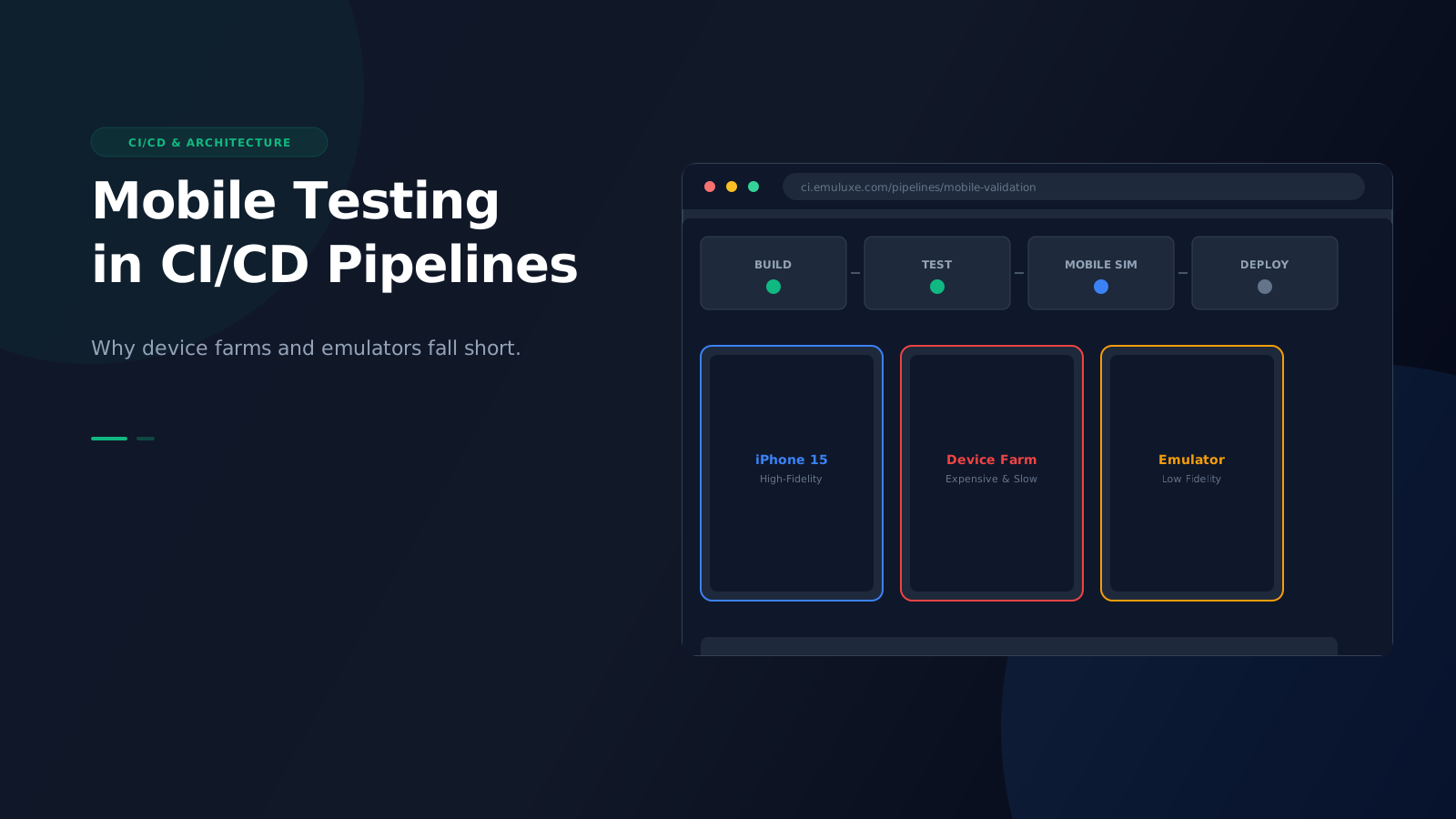
The device farm trap
Device farms like BrowserStack, AWS Device Farm, or Sauce Labs seem like the obvious answer. They give you access to real devices. They integrate with CI/CD. They promise comprehensive coverage.
The problem is the economics and the bottlenecks.
For a team that needs to run mobile checks on every pull request, device farms quickly become unsustainable:
- Cost: Running tests across multiple devices on every commit can cost thousands per month
- Speed: Device availability creates bottlenecks. You wait for devices to free up, or you pay for premium queues
- Parallelization limits: Even when you pay more, there are hard limits on how many sessions you can run in parallel
- Flakiness: Real devices have real variability. Network conditions, battery state, and background processes introduce test flakiness that wastes engineering time
The result is that teams either abandon mobile CI/CD entirely, or they run it so infrequently that it stops being useful.
The emulator dead end
Emulators and simulators seem like the cost-effective alternative. They're free. They run locally. You can spin up as many as you want.
But they fail on fidelity.
An Android emulator or iOS simulator is not the same as a real device. It does not accurately represent:
- Device-specific browser behavior: Chrome on a Pixel 6 behaves differently than Chrome on a Galaxy S22
- Hardware-aware rendering: Notches, dynamic islands, and safe areas are often missing or incorrect
- Touch interaction patterns: Emulators don't replicate the feel of real touch gestures
- Performance characteristics: Emulators run on desktop hardware, so performance issues don't show up the same way
You can run automated tests on emulators, but you can't trust the results. A test might pass on the emulator and fail on the real device because of a safe-area issue that the emulator doesn't render correctly.
This is the fundamental architecture problem: CI/CD needs tests that are both fast and trustworthy. Device farms are trustworthy but not fast. Emulators are fast but not trustworthy.
Why this matters for modern teams
The stakes are higher now because:
- Release cadence has increased: Teams ship daily or weekly, not monthly
- Mobile traffic dominates: For many products, mobile is 70%+ of traffic
- Device fragmentation is worse: iPhones, Androids, foldables, tablets-each with different behaviors
- Client expectations have risen: Agencies and enterprise clients expect mobile quality as a baseline
The old model of "test on a few devices before launch" doesn't work when you're shipping constantly. You need automated mobile validation that runs on every commit without breaking the bank or the build time.
What high-fidelity simulation changes
High-fidelity mobile simulation offers a third path that solves the core architecture problem.
Unlike device farms, it is:
- Cost-effective: No per-minute or per-device pricing
- Fast: Runs locally or in your own infrastructure, no queue times
- Unlimited parallelization: Spin up as many simulations as your infrastructure allows
Unlike emulators, it provides:
- Real device context: Accurate safe areas, notches, and device-specific browser behavior
- Hardware-aware rendering: Layouts render the way they would on actual devices
- Touch interaction simulation: Gestures and interactions behave realistically
- Performance modeling: Can simulate network conditions and device constraints
This combination makes it viable for CI/CD integration in a way that neither device farms nor emulators can match.
How this fits into CI/CD workflows
The strongest CI/CD integration pattern looks like this:
Pre-commit or PR checks
Run high-fidelity simulation against critical pages:
- Landing pages
- Checkout flows
- Auth screens
- Navigation-heavy interfaces
These checks are fast enough to run on every commit without slowing down the development workflow.
Staging validation
When code reaches staging, run a broader simulation suite:
- Multiple device profiles
- Different orientations
- Network condition variations
- Safe-area and notch validation
This catches issues before they reach production.
Production monitoring
Use simulation to validate production pages after deployment:
- Regression checks
- Client-specific configurations
- Region-specific layouts
- Campaign-specific pages
This provides confidence that what you shipped is actually working for mobile users.
Where AI enhances the workflow
AI-powered debugging becomes particularly valuable in CI/CD contexts because:
- Automated issue triage: AI can analyze simulation results and prioritize which issues need human attention
- Root cause analysis: When a test fails, AI can help identify whether it's a layout issue, safe-area problem, or interaction bug
- Fix suggestions: AI can propose code changes based on what the simulation reveals
- Test generation: AI can help generate simulation test cases for new features
The key is that AI sits on top of high-fidelity simulation. The simulation provides trustworthy context. The AI helps teams act on that context faster.
The architectural advantage
The real architectural advantage of high-fidelity simulation in CI/CD is that it decouples mobile validation from physical infrastructure.
With device farms, your mobile testing capability is tied to someone else's infrastructure. You're subject to their pricing, their availability, their limits.
With emulators, your mobile testing capability is tied to desktop hardware that doesn't accurately represent mobile behavior.
With high-fidelity simulation, your mobile testing capability becomes:
- Infrastructure-agnostic: Run it anywhere-localhost, CI runners, cloud infrastructure
- Device-accurate: Get real device behavior without physical devices
- Automatable: Integrate it into any CI/CD pipeline without external dependencies
This decoupling is what makes it a sustainable architecture for modern mobile development.
What teams should actually do
If you're building a mobile CI/CD strategy today:
- Start with high-fidelity simulation for critical paths: Don't try to simulate everything. Focus on the pages where mobile bugs are expensive.
- Add device farm validation for final sign-off: Use device farms sparingly for final validation, not for every commit.
- Treat emulators as development tools, not CI/CD tools: They're fine for local development, but don't rely on them for automated testing.
- Iterate on the simulation suite: Start small, expand based on what actually catches bugs in production.
- Measure the ROI: Track how many mobile bugs you catch before production vs. the cost of your testing infrastructure.
The goal is not to eliminate device farms or emulators entirely. The goal is to use them where they make sense, and use high-fidelity simulation where it provides better value.
The future of mobile CI/CD
As mobile hardware continues to evolve-foldables, dynamic islands, varying safe areas-the gap between emulators and real devices will only widen.
Device farms will remain expensive because maintaining real device inventory is inherently costly.
High-fidelity simulation will become the default for CI/CD because it's the only approach that scales economically while providing trustworthy results.
The teams that win will be the ones that recognize this architectural shift early and build their CI/CD pipelines around simulation-first mobile validation, not device-farm-dependent testing or emulator-based approximation.
Mobile CI/CD is broken today. High-fidelity simulation is the fix.